[EN] The win-win situation hidden behind the Amazonia fires – part 2

How much are preservation and “green” capitalism false solutions worth? Tree burned by the fire alongside BR-367, between Rio Branco and Bujari. Photo: Douglas Freitas / Friends of the Earth Brazil Have you read the first part of the story? Here: The win win As if these direct strikes against the forest and the Peoples living there were not damaging enough, it is also important to be aware of the initiatives that present themselves as “environmental” solutions in the Amazonia. It may be that they are actually more an expression of capitalism and forestry profiteering. According to a member from the Indigenous Missionary Council (CIMI) and a researcher specialised in the financialisation of Nature, Lindomar Padilha, the fire that glows in the Amazonia constitutes a win-win logic for those who are land speculators. For Lindomar, when starting the fire, if the agribusiness agents are unable to implement the cattle raising and later soybean plantations and other commodities, they still have another possibility to make money, including through international funding, which is the discourse of environmental compensation to reforest that which they, themselves, have destroyed. And with this scheme of winning at all costs is the logic of financial capitalism. Specifically when we are talking about carbon credits and the carbon market, highlights Lindomar. He explains, “The markets linked to the Green Economy, at the heart of it all, work as a type of commodity, called ‘credits’, ‘carbon credits’. As in the case of any type of merchandise, when there is a lot, it is cheap. When it is scarce, the price climbs”. Due to this concept, it is necessary to pressure the territories, and that is where fire starts to play a role. “When the jungle burns, the market linked to the REDD+, that of the ‘carbon credits’ ‘says we are selling, we need to make more of a market for compensation, more of a REDD+ market to compensate for the threats that we see in the Amazonia”. So the fires result in an overvaluation of these credits, or shall we say the right to pollute”. To begin to understand, REDD+ is a set of economic incentives for those who avoid greenhouse gas emissions resulting from deforestation or forestry degradation. Broadly speaking, corporations that pollute in excess purchase REDD+ carbon credit from communities or institutions that take care of standing forests. These forests, theoretically speaking, capture carbon from the atmosphere and, supposedly, compensate the pollution caused by the polluter. Sign found at the Chico Mendes Extractivist Reserve, Xapuri, locality of intense sustainable forestry management. Photo: Douglas Freitas / Friends of the Earth Brazil REDD is another capitalist mechanism to appropriate and speculate upon the forest. In the Friends of the Earth publication: “REDD+, the Carbon Market and Cooperation California-Acre-Chiapas: legalising dispossession”, we describe the Acre case, which applies REDD+ through the Acre State’s Incentive System and Environmental Services (SISA), and the varied problems that the communities that have implemented the program have experienced and continue to experience. Not only is it a false environmental solution, as it does not provoke an alteration in the modes of production of the companies and countries that pollute. It also transfers to the South the responsibility to compensate for pollution caused by the North. In June 2018, Indigenous Peoples and communities that live in and work the forest came together in Sena Madureira, Acre to denounce these false solutions proposed by Green Capitalism in response to environmental and climatic depredations. You can read the declaration resulting from this encounter, here. As one of the principal examples of how prejudicial for the communities and the territories is REDD and the carbon credit system, Lindomar highlights the complete loss of tutelage over the territory. To explain this, he compares it to what happens in the real estate market. Through his perspective, the Acre Government is offering the preservation areas as a guarantee for those who will honor the commitments made by the Californian corporations or the German public bank, KFW, owners of the credit in the region. “The State government mortgages the Amazonia forest in the Acre territory. This is a drastic step because you are blocking the process of agrarian regularization, especially for the traditional communities, such as Indigenous Peoples and Extraction reserves. It is as though we are going to say that to demarcate an indigenous territory, we need California and KFW’s authorisation. The market is voracious and there are various, gigantic international entities that are participating in the process of mortgaging off the Acre territories. And without a single explanation to the communities: ‘Look here my good friend, when you accept these REDD and REM mechanisms, you are mortgaging off your life, your own home and your land’. They are going take away your home from underneath you, all we need is a crisis in the financial market and with that they will take away your land, you can be sure”. And to top it all off, the Federal Chamber of Deputies just approved a project to benefit ‘ruralists’ who “preserve” the primary forest, as a Payment for Environmental Service (PSA). Now does this sound interesting? Well the Apurinãs, the rubber tappers and the quilombolas who have always preserved the forest forever and all they are requesting is just the right to the consolidated land, without being invaded. Where is their valorisation? This proposed decree, made by a ‘ruralist’ deputy, would provide that rural producers will receive financial compensation for preserving primary vegetation. This could boost the number of invasions upon land that still has standing forests. And it does not stop there, this payment system for environmental services could be paid to those who plant eucalyptus mono-cultures, with the argument that they are reforesting. Sadly, eucalyptus as a possibility for reforestation is still being discussed in the UN. “The mono-culture does not fit within the concept of an ecosystem because an ecosystem responds to a group of elements that are interrelated. So it is a deceptive idea to adopt a discourse
[EN] The win-win situation hidden behind the Amazonia fires – part 1
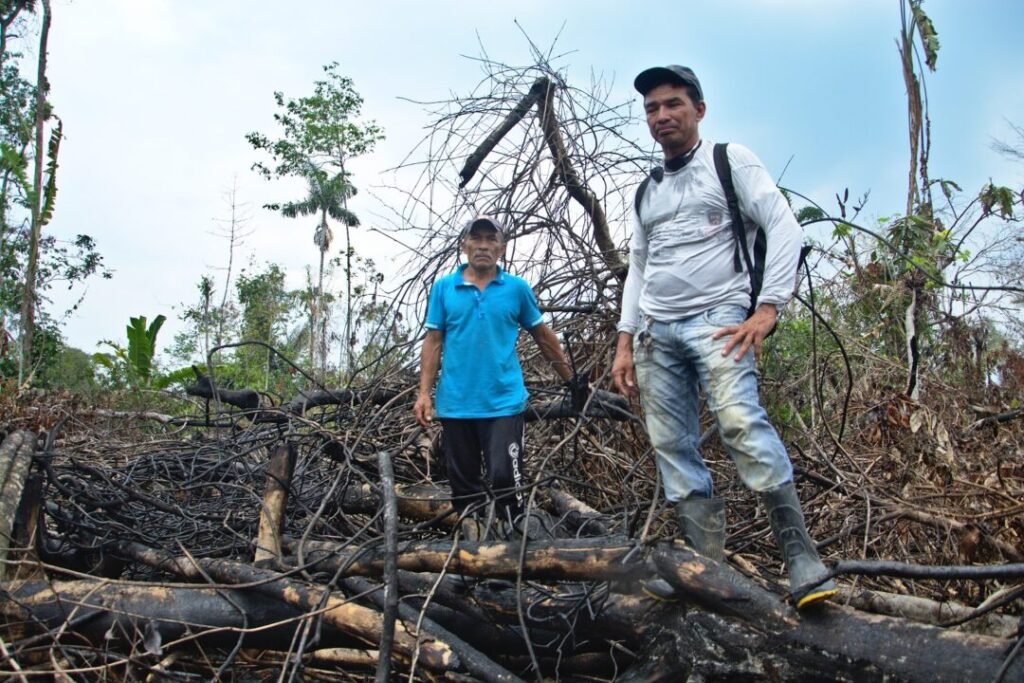
How agribusiness and the financial markets profit from the devastation of the world’s largest tropical forest Text and photos: Douglas Freitas / Friends of the Earth Brazil With his feet upon the ashes where once the forest existed, the Pajé (Shaman) Isaka Huni Kuin expresses his profound sadness. “They do not know the medicine that exists inside the forest. They think it is useless, that it is only woods, but it is extremely valuable. From there, we get our hardwoods from which we construct our homes. When one of our children is sick, I know how to treat them, I know which medicine I have to look for. It is our pharmacy that is alive. If they finish off the forest, the wealth of knowledge that I have ceases with it; all of this fire makes me so very sad.” Pajé Isaka lost his live pharmacy. Photo: Douglas Freitas / Friends of the Earth Brazil On August 22 in a few hours, the flames blazed and burned the five hectares of forest, which corresponds to 50% of the total area of the Cultural Center of the Huwã Karu Yuxibu. Since October 2018, the Cacique Mapu family, Isaka’s son, has made this territory home for relatives that have come to the city to study and also a space to propagate the medicine of the Huni Kuin People, located 50kms from the center of Rio Branco city, capital of Acre State. The Pajé Isaka, 80 years old, was eating lunch with his family when his wife heard the crack of the leaves burning. They started running with their machetes to try to impede the fire´s onrush upon the forest, but they were unsuccessful. With the arrival of the firefighters, they were able to save their homes. The orchards of papaya, banana, açai and other plants were consumed by the fire. The armadillos, turtles and monkeys were also affected. They burnt the forest that was once the Huni Kuin’s pharmacy. Arson is suspected, an act that put at risk the life of Pajé Isaka and his family. For Isaka, it was an act of malice. About 250 kms from there, now in Amazonas State, in the Boca de Acre municipality, the Apurinã People´s forest also burned. On August 13, the Day of the Fire, 600 hectares of the Val Paraiso Indigenous Territory were razed. In the Apurinãs´ territory, the fire is more than just malice, it is one of the many steps in a well-articulated process of land grabbing of federal lands. The Cacique Antonio Jose condemns this scheme that, in the Legal Amazonia, not only affects their territory but also impacts diverse indigenous Peoples and federal lands overall. Through a cycle of destruction and profit, the invaders deforest, sell the precious woods, set the rest of the forest on fire, fence it off, begin to raise cattle in the enclosed area, sell the meat and then finally plant soybeans, corn or rice. And if that were not enough, the agribusiness sector that profits from the international market still even has the opportunity to continue profiting with environmental campaigns where they purport to be “saving” the Amazonia. On the Acre roads, it is common to see tractor trailers loaded with gigantic trunks of wood. Photo: Douglas Freitas / Friends of the Earth Brazil The Apurinã Caciques’ fight against land grabbing and in favour of the demarcation of their territoriesThere were 45,256 fires detected by the National Institute for Space Research (INPE) in the Amazonia from January to August 2019. 20% of the fires took place in public forests that still have not been designated as having a specific category: national parks, reserves or indigenous territories, among them, Val Paraiso Indigenous Territory. On August 13, the Day of the Fire, as denounced by Cacique Antonio Jose, a group of land grabbers burned 600 hectares that have been claimed by the Apurinãs. Cacique Antonio Jose opens the gate which offers access to the Val Paraiso Indigneous Territory. Photo: Douglas Freitas / Friends of the Earth Brazil After we have passed through the fifth gate, we are finally near the entrance to the forest of the Val Paraiso Indigenous Territory, on the banks of the Retiro Stream. The Cacique Kaxuqui gets off his motorcycle; he is Antonio Jose’s cousin and partner in the fight to regain their lands. Antonio invites us to get out of the car because they would like to talk. On the one side of the fence is us and on the other innumerable heads of cattle, which cover the five lots that we have just crossed through. The Caciques explain to us what they see here. “They devastated our land, things that we have been preserving for the last 100 years, where our grandfather, ourgreat-grandfather and uncles were born,” decries Kaxuqui, 58 year-old. Antonio Jose continues: I am 54 years old, and I have never left here. These people, those who claim to be the owner of this land where we are standing right now, they are not from here no, they are descendants of the Portuguese. And we who are indigenous, who have lived here forever, which we have proven, we are here without our right to the land”. Cacique Kaxuqui and Antonio Jose denounce the land grabbing ofindigenous land (in Portuguese). The Apurinãs have demanded the demarcation of the Val Paraiso Indigenous Territory since 1991. The process is in the hands of FUNAI (National Indigenous Foundation). The Indigenous People has been waiting for years for the completion of the studies to identify and delimit the area, where 46 people, consisting of seven families, live. In the beginning of the process, the Apurinãs had lodged a claim for 57 thousand hectares. Even though the area was under judicial review, their lands were invaded, forests were felled, transformed into fields and eventually became cattle ranches. Recently, they decreased the demarcation request to only 26 thousand hectares in order to facilitate the process. “We made an agreement with the plantation owners. What
[ES] Fraport crea escenario de guerra en Brasil: escombros, amenazas y mudanzas ilegales en Vila Nazaré

En televisión, o de un vecino que escuchó de alguien que escuchó en la radio. Así, las familias de Vila Nazaré, una comunidad en la Zona Norte de Porto Alegre, en el sur de Brasil, descubrieron que perderían sus hogares y serían arrojados a otros rincones de la ciudad, lejos de donde se establecieron sus raíces. Todo porque Fraport, una corporación alemana que opera docenas de aeropuertos en todo el mundo, quiere extender la pista de aterrizaje en el Aeropuerto Internacional Salgado Filho, que desde principios de 2018 ha sido asignado a la compañía. El contrato es válido por 25 años. Mientras tanto, entre los aviones y las personas, la prioridad parece clara: los aviones. El primer video es de marzo de 2018 (con subtítulos en inglés); el segundo, septiembre de 2019 (solamente en português). Mientras tanto, Fraport y el Ayuntamiento de Porto Alegre crearon un escenario de guerra en Vila Nazaré, con mucha información errónea y falsas promesas a los residentes. Vila Nazaré alberga hoy a unas 2 mil familias. Son trabajadores que no reciben asistencia del Estado y que, incapaces de pagar el alquiler y los precios de las propiedades en otros lugares, ocuparon áreas ociosas de la ciudad y establecieron su hogar allí. Vinieron principalmente de ciudades en el interior del estado de Rio Grande do Sul, dejando el campo por falta de oportunidades y persiguiendo el sueño de una vida mejor en la capital. Durante más de cinco décadas han construido casas, desarrollado negocios locales y construido lazos familiares, de amistad y de vecindad. Sin embargo, los planes de extensión de la pista del aeropuerto están destinados a barrer a la comunidad del mapa. Lo peor de todo es que la eliminación se planificó de manera arbitraria, autorizada y sin garantías de los derechos de las familias afectadas. No hay un plan de expulsión y las familias se están dividiendo: parte de la gente irá a la asignación “Nosso Senhor do Bom FiM” y parte a la asignación “Irmãos Marista – Timbaúva”, lejos de los servicios básicos de salud, educación y transporte. Los niños que van a la escuela cerca de Nazaré perderán el año escolar; quienes trabajan cerca de la comunidad pueden perder sus empleos, ya que la mayoría son trabajos informales en los que los empleadores no están obligados a pagar el transporte del trabajador; los que van al médico en la clínica de salud al lado de Nazaré pueden perder su atención. La falta de información y transparencia en el proceso es preocupante: en ningún momento se ha escuchado a los líderes locales saber qué piensan los que se verán directamente afectados por las obras. En una audiencia pública convocada por el entonces diputado de estado Pedro Ruas (PSOL), la única vez que todas las partes involucradas en el proceso se reunían con la comunidad, los representantes de Fraport, aunque presentes, se negaron a sentarse a la mesa y responder cualquier pregunta de residentes, que se han posicionado con bastante claridad: no quieren ir a Timbaúva, el lugar más alejado de Nazaré, en la frontera entre los municipios de Porto Alegre y Alvorada. Lo que la mayoría quiere es su derecho a permanecer en la región donde construyeron sus hogares y sus vidas (y son criminalizados por ello). Básicamente, no existe información clara y disponible para las familias que ven amenazado su derecho a la vivienda para saber qué está sucediendo, a dónde van, o adónde van sus familiares, amigos y vecinos: Nosso Senhor do Bom Fim o Timbaúva, y no cuándo, ni de qué manera. Se supone que hay un empate, pero nadie puede decir cómo sucede. Una de las responsabilidades de Fraport era ayudar a trasladar a las familias: de los pocos que ya habían sido retirados (todo para la asignación Nosso Senhor do Bom Fim), los camiones tomaron solo una parte de sus pertenencias y las dejaron frente a los edificios sin ninguna otra ayuda; el dinero que se pagaría por la compra de muebles nuevos se pagó solo una parte. La responsabilidad de Fraport, sin embargo, es mucho más amplia: la Fiscalía Federal y Estatal y los Defensores Públicos Federales y Estatales han llevado a la empresa ante los tribunales, reconociendo la responsabilidad total de la empresa de reubicar a las familias, incluida la construcción de un tercero. alternativa para aquellos que no están satisfechos con las dos opciones ofrecidas hasta ahora, que, considerando que el 85% de las familias serían desalojadas a Timbaúva, representa a la mayoría de las personas. El caso está en el tribunal y, en su primera declaración, el juez reconoció el derecho de las familias a la tercera opción. Sin embargo, dijo que esto debería tratarse más tarde, individualmente, con aquellos que se quedan atrás en los escombros. El juez ni siquiera exigió a Porto Alegre y Fraport un plan de remoción, que muestre claramente quién se va, dónde, cuándo y cómo. Con los límites del sistema judicial local, nos parece clara la importancia de un tratado internacional que regule las operaciones de las empresas transnacionales, como el Tratado Vinculante que se construirá dentro de la ONU. A menudo más ricas y poderosas que los propios estados, las compañías de Norte Global violan los derechos de los pueblos del sur y atacan sus territorios. El gobierno local y Fraport fingen no escuchar a las propuestas de urbanización de Vila Nazaré, mejorando la calidad de vida en la región, lo que garantizaría que las familias permanezcan en su territorio de origen. Durante años, la ciudad de Porto Alegre abandonó el lugar, haciendo la vida imposible allí, para crear un deseo de salida a las familias: la clínica de salud fue cerrada, la escuela de niños también; las calles fangosas están llenas de baches y al principio llueve las casas se inundan de aguas residuales. En su sitio web, Fraport garantiza respetar la diversidad cultural, ética, social, política y legal de todas las naciones y comunidades. Lo que ves es lo contrario. No hay
[EN] Fraport creates war scenario in Brazil: rubble, threats and evictions in Vila Nazaré
On the television, or from a neighbor who heard about it on the radio. This is how the families of Vila Nazaré, a community in the north area of Porto Alegre, southern Brazil, found out that they would lose their homes and be sent to other corners of the city, farther away and far from where they have established their roots. All because Fraport, a German corporation that operates dozens of airports around the world, wants to expand the runway at Salgado Filho International Airport, whose operation has been ceded to the company since 2018. The contract is valid for 25 years. In the meantime, between airplanes and people, the priority seems clear: airplanes. Video from March 2018 (English subtitles available) Vila Nazaré is home to around 2,100 families. They are workers who have been neglected by the government and who, without financial conditions to pay rents elsewhere, occupied idle areas of the city and made their home there. They came mostly from cities in the interior of the state of Rio Grande do Sul, leaving the countryside due to lack of opportunities and pursuing the dream of a better life in the capital. For more than five decades they have built houses, developed local commerce and consolidated family, friendship and neighborhood ties. The airport runway extension plans, however, are intended to sweep the community from the map. And the worst: the removal of residents has been planned in an arbitrary and authoritarian way, without guarantees of rights to affected families. There is no removal plan and families are being divided: part of the people is going to Nosso Senhor do Bom Fim Allotment and part to the Irmãos Marista Allotment in Timbaúva, far from basic health, education and transportation services. Children who go to school near Nazaré will lose the school year; those who work near the village may lose their jobs, as most are informal jobs in which employers are not required to pay for the transportation of the worker; who goes to the doctor at the health clinic next to Nazaré may lose health care services. The lack of information and transparency in the process is worrying: at no time have local leaders been heard so that the thoughts of those who will be directly affected by the works is well known. At a public hearing convened by the then state deputy Pedro Ruas (PSOL), the only time when all parties involved in the process were meeting with the community, representatives of Fraport, despite being present, refused to sit at the table and answer any questions from residents – who have positioned themselves quite clearly: they do not want to go to Timbaúva, the furthest place from Nazaré, on the border between the municipalities of Porto Alegre and Alvorada. What most want is their right to stay in the region where they built their homes and lives. There is basically no clear and available information for families who see their right to housing threatened to know what is going on, or where they are going to, or where their family members, friends and neighbors are going to: if to Nosso Senhor do Bom Fim or to Timbaúva, and when, why, how? One of Fraport’s responsibilities was to help move families: of the few that have already been removed (all to Nosso Senhor do Bom Fim Allotment), trucks took only part of their belongings, and dropped them in front of the buildings without any assistance; the money that would be paid for the purchase of new furniture was paid only a part. Fraport’s responsibility, however, is much broader: the Federal and State Prosecutor’s Offices and the Federal and State Public Defenders have brought the company to court, recognizing the company’s full responsibility for relocating families, including the construction of a third alterntive for those who are not satisfied with the two options given so far – which, considering that 85% of families would be evicted to Timbaúva, represents most people of Nazaré. The case is in court and, in its first statement, the judge recognized the right of families to the third option. However, she said this should be dealt with later, individually with those left behind in the rubble. The judge did not even demand from Porto Alegre and Fraport a removal plan, which clearly shows who leaves and where and when and how. With the limits of the local judicial system, it seems clear to us the importance of an international treaty that regulates the operations of transnational corporations, such as the Binding Treaty that will be built within the UN. Often richer and more powerful than the states themselves, North Global companies violate the rights of the southern peoples and attack their territories. Local government and Fraport pretend nothing of what’s happening is their problem, not listening to Vila Nazaré’s urbanization proposals, what could improve the quality of life in the region and ensure that families stay in their territory. For years the city of Porto Alegre abandoned Vila Nazaré, making life impossible there in order to create a “desire of leaving” in the families: the health clinic was closed, the children’s school as well; the muddy streets are potholed and at first rain the houses flood with sewage. On its website, Fraport guarantees to respect the cultural, ethical, social, political and legal diversity of all nations and communities. What you see is the opposite: there is no dialogue or transparency, while threats of removal, authoritarianism and disinformation remain. With each family removed from Vila Nazaré, tractors soon come to tear down the houses; only rubble stays behind, in a sad scenario of war. All in the name of airplanes and on behalf of the profits of a German transnational corporation.
Fraport cria cenário de guerra na Vila Nazaré: escombros, ameaças e remoções ilegais
Pela televisão, ou de um vizinho que ouviu de alguém que ouviu no rádio. Assim as famílias da Vila Nazaré, comunidade na Zona Norte de Porto Alegre, sul do Brasil, descobriram que perderiam suas casas e seriam despejadas para outros cantos da cidade, distantes e longe de onde firmaram suas raízes. Tudo porque a Fraport, corporação alemã que opera dezenas de aeroportos pelo mundo, deseja ampliar a pista do Aeroporto Internacional Salgado Filho, cujo funcionamento desde o início de 2018 foi cedido à empresa. O contrato vale por 25 anos. Nesse meio tempo, entre aviões e pessoas, a prioridade parece clara: os aviões. O primeiro vídeo é de março de 2018; o segundo, de setembro de 2019. Nesse meio-tempo, Fraport e prefeitura de Porto Alegre criaram um cenário de guerra na Vila Nazaré, com muita desinformação e falsas promessas para moradoras e moradores. A Vila Nazaré abriga hoje cerca de 2 mil famílias. São trabalhadoras e trabalhadores desassistidos pelo Estado e que, sem condições financeiras de arcar com os preços dos aluguéis e imóveis em outras partes, ocuparam áreas ociosas da cidade e ali fizeram a sua morada. Vieram, na maioria, de cidades do interior do Estado do Rio Grande do Sul, abandonando o campo devido à falta de oportunidades e perseguindo o sonho de uma vida melhor na capital. Durante mais de cinco décadas construíram casas, desenvolveram comércio local e consolidaram vínculos familiares, de amizade e de vizinhança. Os planos de extensão da pista do aeroporto, porém, pretendem varrer do mapa a comunidade. E o pior: a remoção vem sendo planejada de forma arbitrária, autoritária e sem garantias de direitos às famílias afetadas. Não há nenhum plano de remoção e as famílias estão sendo divididas: parte das pessoas estão indo para o Loteamento Nosso Senhor do Bom Fim e outra parte para o Loteamento Irmãos Marista, no Timbaúva, longe de serviços básicos de saúde, educação e transporte. Crianças que vão à escola perto da Nazaré perderão o ano escolar; quem trabalha perto da vila poderá perder o trabalho, já que, na maioria, são empregos informais nos quais os empregadores não são obrigados a bancar pelo transporte da trabalhadora ou trabalhador; quem vai ao médico no posto de saúde ao lado da Nazaré poderá perder seu atendimento. A falta de informação e transparência no processo é preocupante: em nenhum momento as lideranças locais foram ouvidas para que se saiba o que pensam aqueles que serão diretamente atingidos pelas obras. Em audiência pública convocada pelo então deputado estadual Pedro Ruas (PSOL), único momento em que todas as partes envolvidas no processo estiveram reunidas junto à comunidade, representantes da Fraport, ainda que presentes, recusaram-se a sentar na mesa e responder qualquer questionamento dos moradores – que se posicionaram de forma bastante clara: não querem ir para o Timbaúva, local mais distante da Nazaré, nos limites entre os municípios de Porto Alegre e Alvorada. O que a maioria deseja é o seu direito de permanecer na região onde construíram suas moradias e vidas (e são criminalizados por isso). Não há, basicamente, informações disponíveis e claras para que as famílias que veem ameaçado o seu direito à moradia saibam o que se passa, ou para onde vão, ou para onde seus familiares, amigos e vizinhos vão: não se sabe quem vai para o Nosso Senhor do Bom Fim ou para o Timbaúva, e nem quando, e nem de que jeito. Há, supostamente, um sorteio – mas ninguém sabe dizer como ele ocorre. Uma das responsabilidades da Fraport era ajudar na mudança das famílias: das poucas que já foram removidas (todas para o Loteamento Nosso Senhor do Bom Fim), caminhões levaram apenas parte dos pertences, e os largaram em frente aos prédios sem nenhum auxílio extra; o dinheiro que seria pago para a compra de novos móveis foi pago apenas uma parte, como crédito de R$2 mil em uma loja específica. A responsabilidade da Fraport, porém, é muito mais ampla: os Ministérios Públicos Federal e Estadual e as Defensorias Públicas da União e do Estado acionaram a empresa na Justiça, reconhecendo a responsabilidade total da empresa no realojamento das famílias, inclusive na construção de uma terceira alternativa para quem não estiver satisfeito com as duas opções dadas até agora – o que, considerando que 85% das famílias seriam despejadas para o Timbaúva, representa a maior parte das pessoas. O caso está na Justiça e, em sua primeira manifestação, a juíza reconheceu o direito das famílias à terceira opção. Contudo, disse que isso deve ser tratado mais tarde, individualmente com quem ficar para trás em meio aos escombros. A juíza sequer exigiu da prefeitura de Porto Alegre e da Fraport um plano de remoção, onde se mostre, com clareza, quem sai e para onde e quando e de que jeito. Com os limites do sistema judiciário local, parece-nos clara a importância de um tratado internacional que regule a atuação das empresas transnacionais, como o Tratado Vinculante a ser construído no âmbito da ONU. Muitas vezes mais ricas e poderosas que os próprios estados, empresas do Norte Global violam direitos dos povos do Sul e atacam seus territórios. Governantes locais e a empresa Fraport tapam os ouvidos às propostas de urbanização da Vila Nazaré, de melhoria na qualidade de vida na região, o que garantiria que as famílias permaneçam no seu território de origem. Por anos a prefeitura de Porto Alegre abandonou o local, impossibilitando a vida ali, com o intuito de criar o desejo de saída nas famílias: o posto de saúde foi fechado, a escola infantil também; as ruas de barro são esburacados e à primeira chuva as casas inundam com esgoto. Em seu website, a Fraport garante respeitar a diversidade cultural, ética, social, política e legal de todas as nações e comunidades. O que se vê é o contrário. Não há diálogo nem transparência, ao passo que sobram ameaças de remoções, autoritarismo e desinformação. A cada família removida da Vila Nazaré, tratores vêm logo derrubar as casas; ficam para trás os escombros. Um